
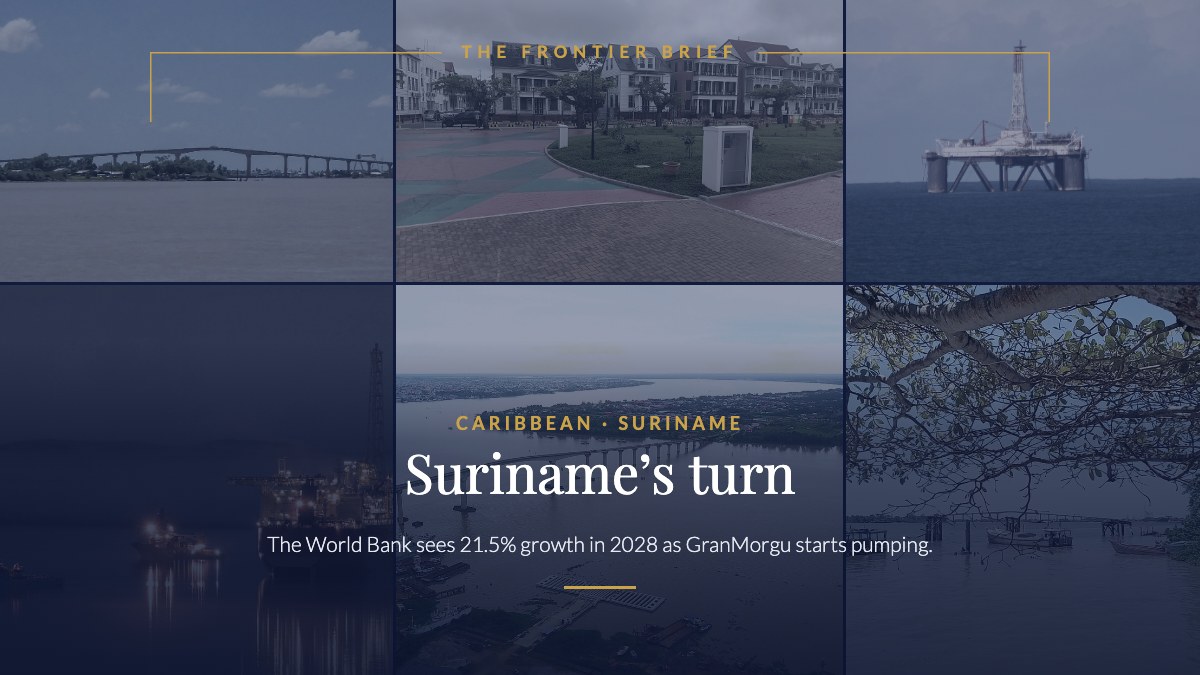
For the first time, a World Bank forecast puts Suriname’s growth ahead of its famous neighbour’s: 21.5% in 2028, the year its first offshore oil project is due to start producing.
The World Bank’s October 2026 Latin America and the Caribbean Economic Update projects Suriname’s economy will grow 3.9% this year, 4.6% in 2027 and 21.5% in 2028. Guyana, still the region’s fastest-growing economy, is projected at 23.7% this year, 18.7% next year and 15.3% in 2028 — which makes 2028 the first year in the bank’s forecasts in which Suriname grows faster.
The reason has a name. GranMorgu, in offshore Block 58, is operated by TotalEnergies with 40%, alongside APA with 40% and the state oil company Staatsolie with 20%. The partners took the final investment decision in October 2024 on a project of around $12 billion, of which about half has now been spent. A floating production vessel with capacity for 220,000 barrels a day is due to start producing in mid-2028. The discoveries behind it hold more than 2.4 billion barrels of oil and liquids and more than 12.5 trillion cubic feet of gas.
Why it matters
The forecast is not a race result: Guyana’s economy entered 2026 about six times larger than Suriname’s in dollar terms. What it shows is the pattern repeating along the Guiana coast. A single offshore project of this size is enough to transform a small economy within a year, and Suriname has watched its neighbour go through the same thing. With Staatsolie holding a 20% share of the project, the state has a direct stake in the barrels, not only in the taxes — a choice that will shape how much of the boom stays in Paramaribo.
The preparations are already visible on the shore. At the Dr. Jules Sedney port in Paramaribo, pile driving began in September for a new 140-metre quay, financed by Hakrinbank and due within twelve months. Tenaris has opened a 74,500 m² service centre in the capital to prepare the casing and tubing for TotalEnergies’ wells, and a ten-year agreement with the Kuldipsingh Port Facility is turning it into an integrated logistics base for the project. The months before first oil are when the shape of the boom is decided: local content, the fund that will receive the revenues, the skills of a workforce that has never run an FPSO. The World Bank’s numbers put a date on the transformation. Suriname now has a year and a half to get ready for it.
Sources: World Bank, LAC Economic Update (October 2026) · Ocean Energy Resources · De West · Tenaris · Journal of Petroleum Technology (SPE) · Guyana Chronicle