
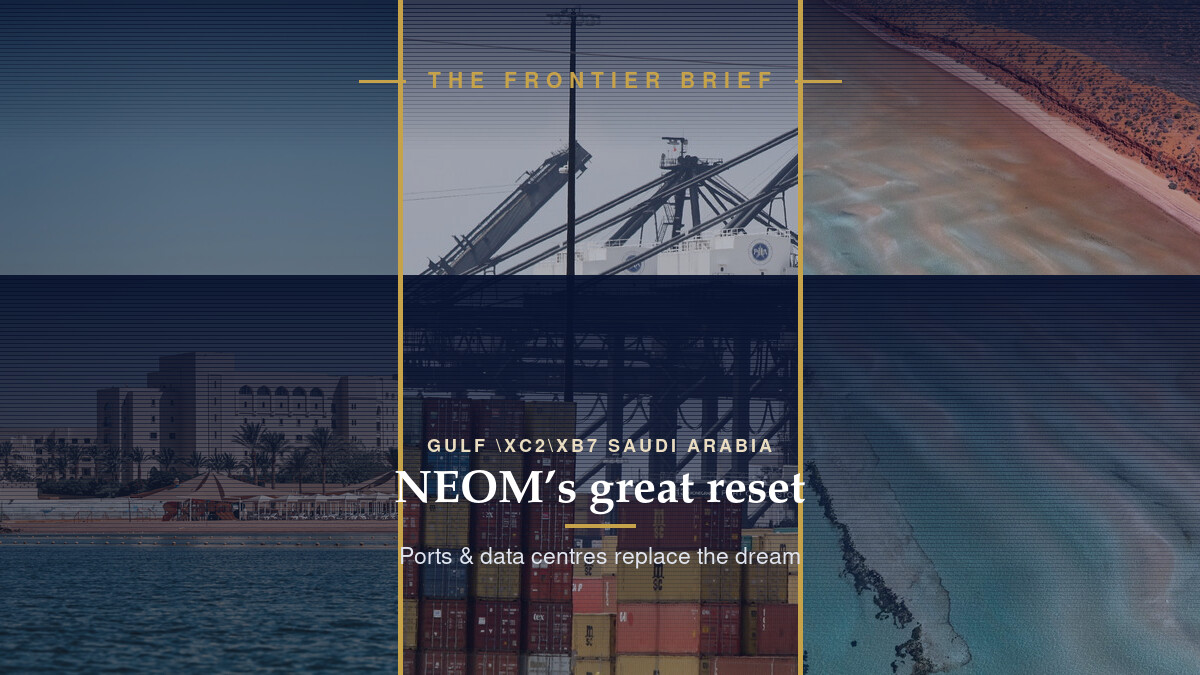
With The Line frozen until after 2030 and roughly $16 billion budgeted just to exit its own contracts, Riyadh is quietly rebuilding NEOM around Oxagon’s data centres and a container port designed to bypass the Strait of Hormuz.
For nearly a decade, NEOM was Saudi Arabia’s most extravagant promise: a $500 billion futuristic region anchored by The Line, a 170-kilometre mirrored city meant to house nine million people. In 2026 that vision is being formally scaled back. Construction on The Line was suspended in September 2025, and on 22 May 2026 NEOM halted the project until after 2030, redesignating the industrial city of Oxagon as its priority node. The retreat has been expensive: Webuild’s EUR 1.4 billion Connector rail contract and a $4.7 billion Trojena dam were terminated, Hyundai Engineering’s tunnelling section and Eversendai’s Trojena structural-steel package were both cancelled in March 2026, and NEOM’s 2026–2030 budget earmarks roughly $16 billion simply to pay contractors to walk away from long-term agreements. The Asian Winter Games, once NEOM’s marquee event, were moved from Trojena to Almaty.
What replaces the utopia is far more grounded — and potentially far more bankable. NEOM is pivoting toward hard infrastructure that exploits genuine geographic advantages: compute and logistics. DataVolt has been awarded a $5 billion AI data-centre campus at Oxagon, and Hexagon a $2.7 billion data-and-AI infrastructure contract, with the coastline’s access to abundant seawater cooling cited as the decisive edge. In parallel, NEOM Port has reached an advanced operational stage, positioned as a Red Sea logistics hub linking Europe to the Gulf Cooperation Council; its main container terminal targets 1.5 million TEU of capacity and is expected to open in 2026, with officials framing it as a route that bypasses the congested Strait of Hormuz to reach global export markets.
Why it matters
The retreat is the story. The Gulf’s most theatrical megaproject is being rationalised into the two assets that actually earn a return in the 2020s: data centres and ports. Stripped of its science-fiction framing, NEOM is converging on the same corridor-and-compute logic reshaping frontier economies from Astana to Baku — monetising geography rather than spectacle. For a kingdom trying to prove that Vision 2030 can deliver cash flow, not renderings, the quiet pivot may prove more consequential than the city it replaced.
Sources: Semafor · Arabian Business · Engineering News-Record · The National · Euronews