
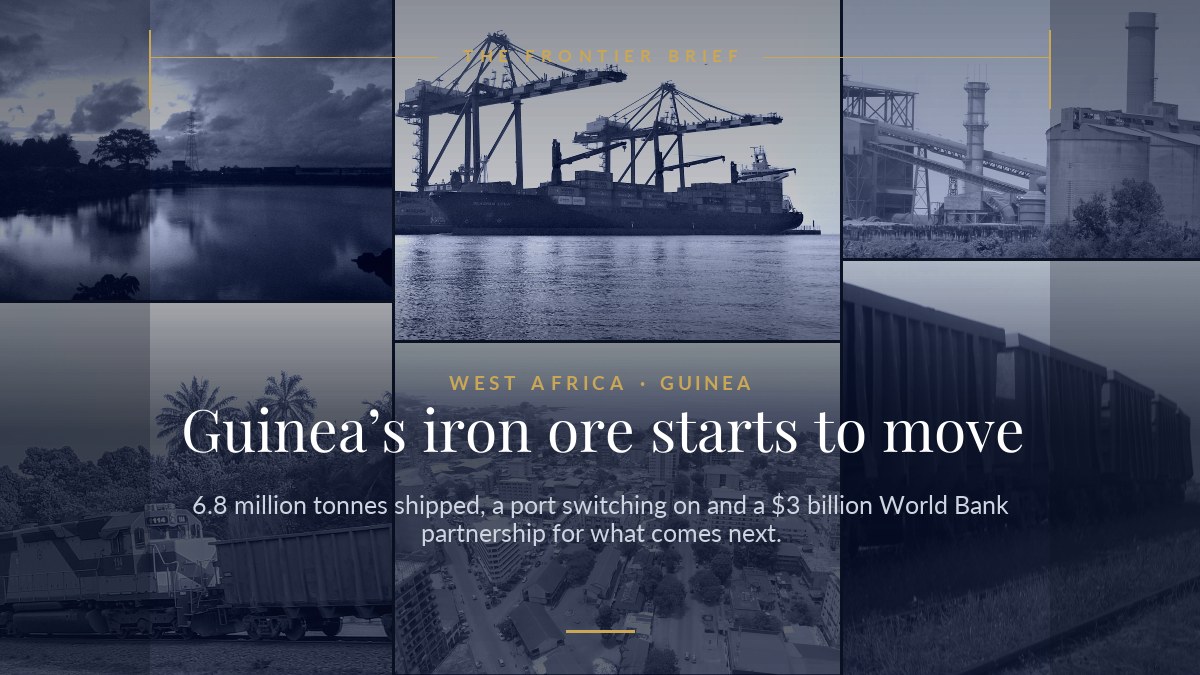
Simandou shipped 6.8 million tonnes of ore in the first half of 2026. In the first week of October the World Bank signed $320.8 million for agriculture, energy and tax administration in Conakry — the first slice of a $3 billion partnership built around one question: what the ore pays for.
The World Bank signed $320.8 million of support for Guinea’s agriculture, energy and tax administration at a ceremony in Conakry in the first week of October, part of a wider country partnership worth $3 billion over 2027–33. Ousmane Diagana, the bank’s vice-president for Western and Central Africa, called Simandou a “historic” opportunity and an “economic turning point” for the country. Mariama Ciré Sylla, the minister of economy, finance and budget, put the government’s aim as turning that wealth into “sustainable shared prosperity”.
The mine is no longer a promise. Production began in late 2025 and 6.8 million tonnes of ore were shipped in the first half of 2026. On 8 September SimFer — the joint venture of the Guinean state, Rio Tinto and a Chinalco-led consortium that holds two of the four blocks — began staged commissioning of the stockyard, stacker-reclaimers and shiploaders at its own port at Morebaya, which was 85% complete at mid-year and is due to be fully commissioned in the first quarter of 2027. Until then its ore travels down the shared railway, more than 650 km of it, and out through the port of Winning Consortium Simandou, the Baowu-backed group that holds the other two blocks. Together the two operations are designed to export up to 120 million tonnes a year. The state holds 15% of each mining company and 15% of the company that runs the rail and port.
Why it matters
The IMF expects mining to lift Guinea’s growth to 8.7% this year and 9.3% in 2027, from 6.7% in 2025. The harder number is 33%: the World Bank’s estimate of the poverty rate. The government’s answer is Simandou 2040, a national plan built on five pillars — agriculture, education, infrastructure, finance and healthcare — with a target of $300 billion of investment across sectors; in September the Council of Ministers set five requirements for the programme, including rules on how the state’s share of the proceeds may be used. That is the part investors outside mining should read. The railway was built for ore, but what else moves along that corridor, and on what terms, is where the non-mining economy begins.
The money is starting to follow. On 6 October AFG Bank Guinée — the former Société Générale Guinée, bought by Atlantic Group’s AFG Holding in 2025 — signed €60 million with Proparco, the private-sector arm of the French development agency: a €35 million loan for small and medium-sized companies and €25 million in trade-finance guarantees. The bank’s target is to double its SME book to €120 million by 2027. Guinea also banned exports of raw gold earlier this year to push refining at home. None of this is the size of Simandou. It is the direction: a country using a mine to finance the things a mine does not build.
Sources: Bloomberg · Mining.com.au · SimFer / Rio Tinto · The Rio Times · Energy Capital & Power · IMF · World Bank