
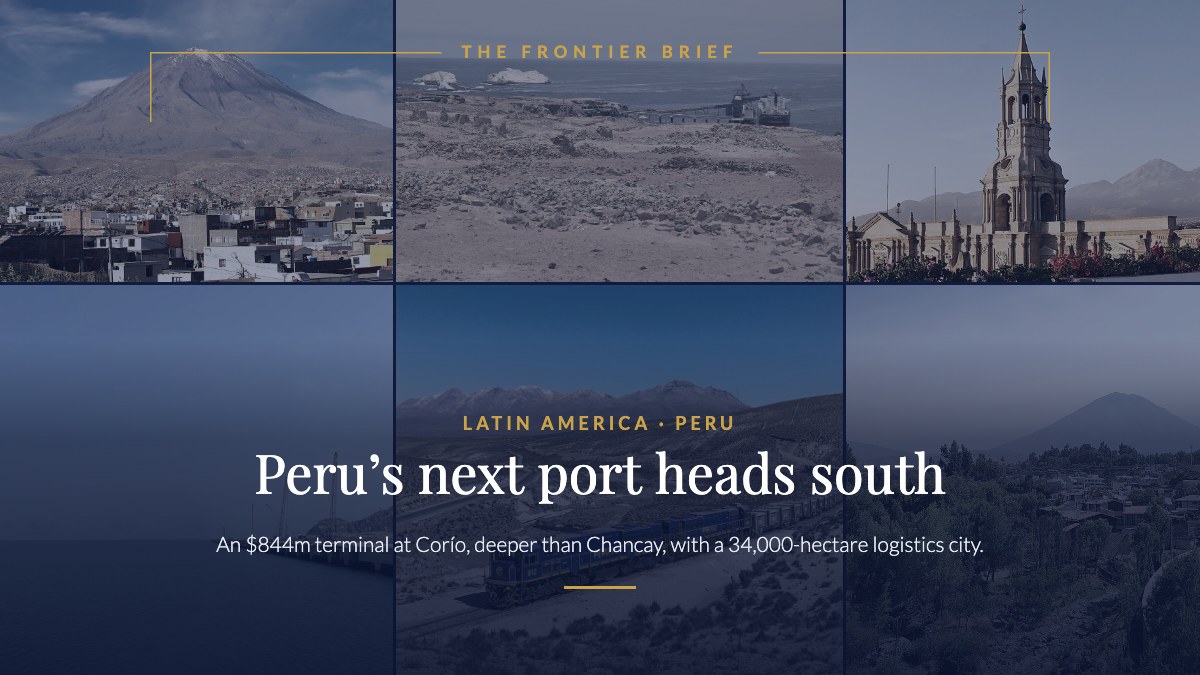
Two years after Chancay opened in the north, Peru has started marketing a second deep-water gateway in the south — a multipurpose terminal and logistics city at Corío, in Arequipa, aimed at Brazil, Bolivia and the Asia-Pacific.
On 12 October, ProInversión, Peru’s private-investment agency, signed an agreement with the Regional Government of Arequipa to promote the Corío port and logistics corridor to domestic and foreign investors. The estimated investment is $844.5 million. The plan combines a multipurpose terminal for general cargo and containers with a logistics city of more than 34,000 hectares, with distribution centres, storage and industrial parks, designed to link southern Peru with Brazil, Bolivia and Asia-Pacific markets.
Interest arrived before the paperwork was dry. “Several companies have approached us,” said Arequipa’s governor, Rohel Sánchez, adding that investors from the United States, China and India are “very interested”, alongside companies from Turkey and the Netherlands, while South Korean investors are looking at technology for the logistics park. ProInversión’s president, Luis del Carpio, did not rule out using the port to ship copper from the region to Asia. According to Reuters, the terminal is expected to offer a deeper draught than Chancay, the northern megaport operated by China’s COSCO Shipping Ports since late 2024.
Why it matters
Chancay showed what a single deep-water port can do to Peru’s position on the Pacific: it put the country on direct routes to Asia. Corío would do the same for the south, where Peru’s copper belt sits and where landlocked Bolivia and Brazil’s western states look for the shortest way to the Pacific. A port with investors from Washington, Beijing and New Delhi all asking questions is also a port Peru can negotiate on its own terms. And it is not alone: China’s Jinzhao is set to start building a $405m port at Marcona, in Ica, in 2027.
The numbers presented in Lima show the scale of the ambition. The investment comes in three stages: $652 million for the first, a further $109 million for an additional bulk berth, storage and a rail link, and $83 million for a third specialised berth. The port core would cover 1,127 hectares, and the most optimistic scenarios project up to 19 million tonnes of bulk and 932,000 tonnes of general cargo a year by 2030. The governor expects the port itself to be developed as a public-private partnership. “The true dimension of Corío will be, beyond the port, the investment in industry, jobs and economic activity,” said ProInversión’s Del Carpio. Nothing has been awarded yet, and no construction date has been set. But the direction is clear. Peru is turning its coast into a series of competing gateways — north, centre and now south — and inviting the world’s big trading powers to bid for them.
Sources: El Peruano · ProInversión · Reuters via Baird Maritime · Gestión · AgriBrasilis · Latin Times