
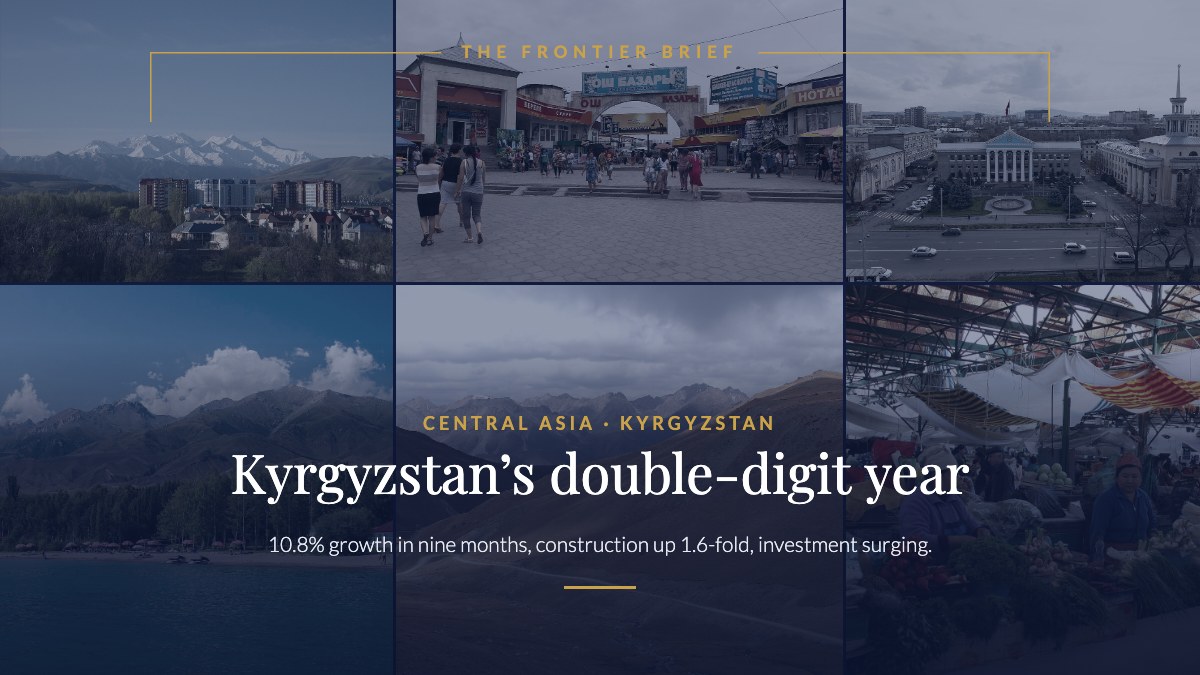
One of Central Asia’s smaller economies is now its fastest-growing. New official data show Kyrgyzstan’s GDP up 10.8% in the first nine months of 2026, driven by a construction and investment boom.
Figures released on 15 October by Kyrgyzstan’s National Statistical Committee show the economy reached 1.64 trillion soms, about $18.8 billion, in January–September, a real increase of 10.8% on the same period of 2025. Services made up 48.7% of output and goods production 35.9%. Construction output rose more than 1.6-fold, industry grew 7%, agriculture 6.5% and hotels and restaurants 8.6%. Trade in goods reached $12 billion in the first eight months, up 13.3%.
The engine is investment. The Eurasian Development Bank, which forecasts 10.2% growth for the full year, found that total investment rose 58.8% in the first seven months, bank financing for investment more than quadrupled, and foreign-financed fixed capital investment rose more than fifteenfold. Budget revenues were up 48.8% in the first half, leaving a surplus of 6.1% of GDP. The EBRD, which forecasts 8.7% for 2026, ranks Kyrgyzstan as the fastest-growing economy in Central Asia and Mongolia, and the IMF’s new World Economic Outlook expects 9% this year after 11.1% in 2025. Capital investment reached 365.7 billion soms in the first nine months.
Why it matters
For a mountainous country of seven million with no sea and few large mines, growth of this kind is unusual. It is happening because money is going into the ground: investment, construction and tourism, financed by banks and foreign capital, alongside a state that is collecting more revenue than it spends. In Baku this week, President Sadyr Japarov used the CICA summit to invite investors into the Tamchy special financial and investment zone on Lake Issyk-Kul. The pitch now comes with a number attached.
Two figures temper the picture: consumer prices have risen 8.1% since December, and the IMF expects inflation to average 12.7% this year, well above the central bank’s 5–7% target. But a budget in surplus and investment rising faster than consumption suggest the boom is building assets, not only spending. The question for 2027 is whether Bishkek can turn a year of double-digit growth into a decade of steady growth.
Sources: National Statistical Committee of the Kyrgyz Republic via Xinhua · Caspian Post · The Times of Central Asia · Eurasian Development Bank · EBRD · IMF World Economic Outlook (October 2026) via Trend · AKIpress