
A Century at the Centre of Growth
Steamships, one of Papua New Guinea’s longest-established companies, is positioning itself for what it sees as the country’s next major growth cycle, drawing on more than a century of operating experience to navigate risk, scale investment and build long-term value
Founded in 1918, Steamships has been embedded in Papua New Guinea’s economy for 107 years, evolving alongside the country itself. What began as a small coastal shipping operation has become a diversified group focused on logistics, hospitality and property — sectors that sit at the heart of national development. For Chris Daniells, Managing Director of Steamships, longevity is not simply a historical footnote but a strategic advantage. “We’ve been here for 107 years,” he said. “That makes us one of the country’s oldest continuous trading companies.”
By the 1960s, 1970s and 1980s, Steamships operated across much of Papua New Guinea’s supply chain. Over time, however, the business environment changed. Increased competition and overseas investment meant many sectors became commoditised, prompting a strategic reassessment. “Over time, a lot of those sectors became quite commoditised,” Daniells said. “We really started to focus on the areas where we thought we could be successful.”
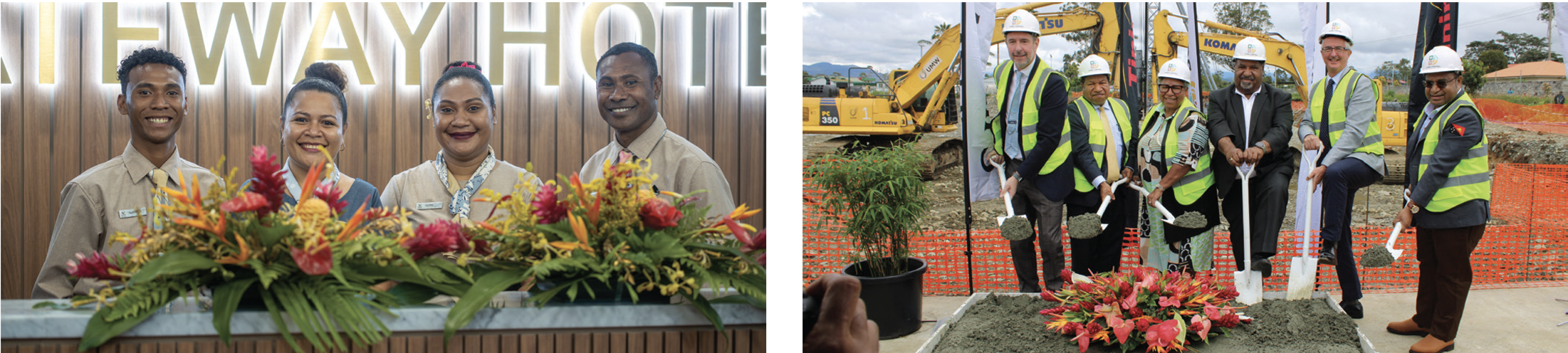
Today, Steamships employs over 3,000 Papua New Guineans and is concentrated on three core divisions: logistics, hospitality and property. The shift reflects a deliberate move away from breadth towards depth, with capital deployed where scale and competitive advantage can be sustained. “It was all about building competitive advantage,” Daniells explained. “Not only building businesses that help build the nation, but businesses where we can develop real scale.”
That focus is closely tied to Papua New Guinea’s geography. As the largest economy in the South Pacific, PNG relies heavily on maritime transport. Almost all domestic and export goods move by sea, often through remote and challenging locations. While this creates operational complexity, it also exposes gaps in infrastructure. “Nearly everything has to move by sea freight,” Daniells said. “The supply chain is still relatively unsophisticated, and that’s where the opportunity is.”
Steamships sees significant potential in developing integrated logistics solutions, particularly in third-party logistics, warehousing and depot infrastructure. Reflecting that view, the group has acquired a 30-hectare site near Port Moresby’s international port — a long-term project expected to take up to a decade to fully develop. Initially focused on logistics, the site will also support mixed-use development as industrial activity shifts away from the city centre. “You can’t start investing as soon as you see the growth,” Daniells noted. “You need to invest ahead of the curve.”
That long-term orientation extends to how the company approaches capital allocation.
While diversification once played a role in building resilience, Daniells believes excessive diversification can become a constraint in a market like PNG. “There’s only so much capital you can deploy,” he said. “The question is whether you want to deploy that capital to build scale or to get into different sectors.”
A cornerstone of Steamships’ success is the company’s unique approach to local partnerships. The group’s joint venture model has become a benchmark for local content, particularly in its port operations. By partnering directly with local landowner groups, Steamships ensures that the benefits of national trade are felt at the grassroots level.
“Our joint venture partnerships are a fundamental part of how we do business,” Daniells explains. “It’s a model built on mutual trust. By partnering with local landowners, we aren’t just creating jobs; we are creating equity and long-term wealth for the communities we operate in. This has proven to be a sustainable business model that positively impacts communities and drives meaningful progress.”
Steamships is comfortable with its current structure and sees ample opportunity within its existing divisions over the next two decades, from fleet renewal in coastal shipping to precinct-style property developments that integrate hotels, retail and commercial space.
Hospitality offers a clear example of how quickly demand can shift. Port Moresby’s hotel market can move from moderate occupancy to full capacity almost overnight, driven by major events or project activity. “Port Moresby gets very full very quickly,” Daniells said. “All it takes is one major project or event and every hotel is full.” Accepting that volatility is part of investing ahead of demand, particularly in a market where supply cannot be created overnight.
Looking ahead, Daniells believes Papua New Guinea is entering a new phase. After a challenging decade, including the impact of COVID-19, several major resource projects are now approaching development. “The last major project had a significant impact on the economy,” he said. “Now there are three or four projects of a similar size on the horizon, and the country is better prepared than it was before.”
Greater emphasis on landowner participation, local investment and skills development is expected to ensure broader economic benefits. For Steamships, the relationship is reciprocal. “PNG is our home,” Daniells said. “This is where we have done business for more than a century, and it will remain our home.” In return, the company sees itself as a stable, long-term presence in the economy. “We’re here to stay,” he said. “And to build a talented local workforce and the resilience of our partnerships through both the good times and the difficult.”