
For much of the past five years, the narrative around Hong Kong was defined by disruption. Political unrest, pandemic isolation and geopolitical friction tested confidence and thinned the expatriate ranks. The city’s linguistic soundscape shifted, too, with Mandarin increasingly prominent. Yet beneath the surface, a rebalancing was underway. Today, a quieter confidence is emerging, rooted not in nostalgia for an earlier era, but in a pragmatic strategy that blends global connectivity with China’s scale.
At the heart of that recalibration is a question of identity. “It’s been a quest for Hong Kong identity,” said Douglas Young, co-founder and CEO of Goods of Desire. His brand—created in the mid-1990s as the city prepared for the handover—was conceived as “unapologetically Hong Kong,” defying the prevailing assumption that only European aesthetics could command premium demand. Survival, he argues, has been the proof point. “I’ve been able to last all this time,” he said, adding that authenticity, rather than global scale, has been the strategic constant.
Rebuilding Confidence Through Capital
If culture anchors Hong Kong’s sense of place, finance is the engine of its renewal. Capital markets are stirring again as Chinese companies turn to Hong Kong for offshore listings, fundraising and global expansion. That revival is being mirrored in the city’s commercial core.
Residential transaction volumes have rebounded, while Central, long Hong Kong’s bellwether district, is showing early signs of leasing recovery. “Residential volume has been picking up,” said Andrew Fung, executive director and CFO of Henderson Land Development. “Commercial is still very flat, but there’s a revival of leasing in Central.”
The recovery is selective rather than cyclical. Higher interest rates and expensive land acquired during the zero-rate years have constrained margins, but cash flow is improving as projects complete and sell through. “2025 is better than the last few years,” Fung said. “But it’s not comparable to the zero-interest-rate period. It’s a different time altogether.”
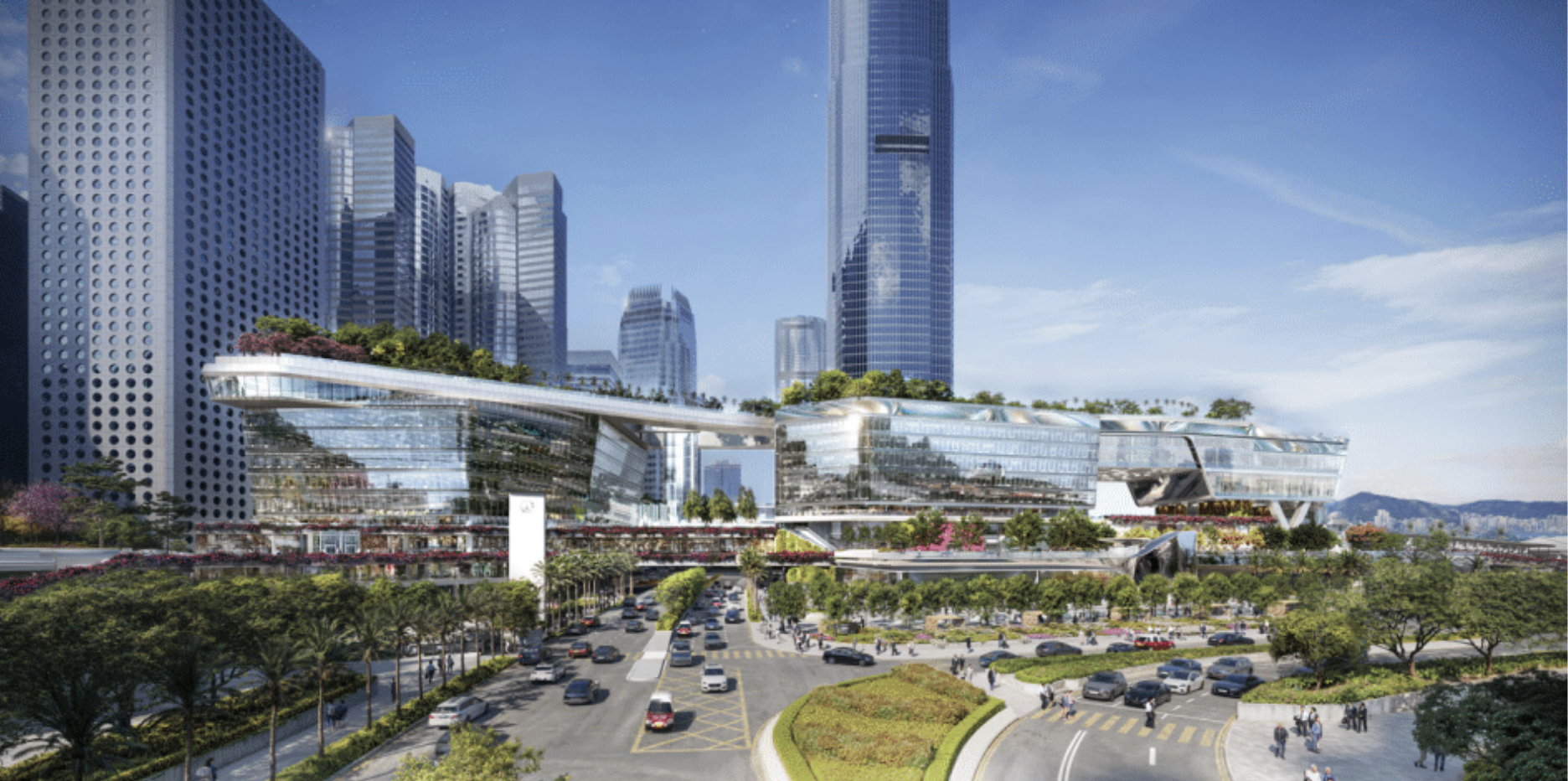
Henderson Land’s response has been to tilt toward recurring income and premium assets, particularly in Central, where supply remains structurally limited. The strategy reflects a broader shift among developers: resilience now depends less on volume and more on location, tenant quality and building performance. “Central is unique,” Fung noted. “We don’t have too many investment properties outside Central.”
ESG as Strategy, Not Slogan
That emphasis on quality has elevated environmental, social and governance standards from marketing add-ons to commercial necessities. International tenants—especially from the U.S. and Europe—now screen buildings on ESG credentials as rigorously as on rent. “If you don’t have ESG,” Fung said, “many companies will rule you out.”
New-generation office developments are being designed for energy efficiency, advanced digital infrastructure and flexible layouts that suit trading floors, data-intensive firms and cultural tenants alike. Henderson Land’s flagship Central projects, Fung explained, were conceived with those demands in mind—from optical-fiber capacity to ceiling heights and non-water fire suppression—reflecting how tenant expectations have evolved since the last major development cycle.
Energy, Scale, and the Mainland Link
While property and finance are central to the city’s rebound, energy and infrastructure reveal how Hong Kong companies are translating credibility into mainland scale. Peter Wong, managing director of The Hong Kong and China Gas Company (Towngas), describes a utility that has repeatedly reinvented itself over more than a century.
Founded in 1862, Towngas now serves a mature Hong Kong market—where growth is incremental and weather-dependent—while operating at scale across mainland China through hundreds of city-gas joint ventures. “Hong Kong’s city-gas business is mature,” Wong said. “So we’re looking at other ways for business expansion.”
That expansion has focused on transition fuels and platforms that align with China’s carbon targets. Towngas already contains a significant hydrogen component, Wong noted, providing a bridge to hydrogen applications ranging from industrial use to temporary power for construction sites. Across the mainland, Towngas has paired gas supply with rooftop solar, energy management and storage solutions to support “net-zero” industrial parks.
The logic is straightforward: Hong Kong brings safety standards, operational discipline and international credibility; the mainland brings demand and scale. “Safety and service standards are why cities welcomed us as a partner,” Wong said, pointing to practices—such as regular household inspections—that later became national benchmarks.
Beyond China, Towngas is positioning for aviation and marine transitions through sustainable aviation fuel and green methanol projects, reflecting a strategy that looks past the current cycle toward long-term decarbonization mandates.
Soft Power and the Search for Place
Yet Hong Kong’s comeback is not solely about balance sheets. It is also about soft power—the less tangible assets that make a city legible to the world. Young argues that Hong Kong’s international relevance depends on expressing a distinct identity, not diluting it. “I would like [the brand] to be recognized as a cultural force for Hong Kong,” he said, helping the city establish icons that resonate globally.
That thinking extends beyond retail. Young has spoken about architecture and hospitality as the next frontier for expressing a Hong Kong aesthetic—luxurious but local, international yet unmistakably rooted in place. Such ideas echo a broader recognition that competitiveness now includes cultural clarity as much as regulatory efficiency.
What makes the current moment different from past downturns is the persistence of Hong Kong’s institutional advantages. The city still offers a low, simple tax regime; free flow of capital; a fully convertible currency pegged to the U.S. dollar; and a legal system aligned with international norms. Government initiatives aimed at biotechnology, medical innovation and technology—backed by world-class universities—signal an effort to move up the value chain rather than compete on cost.
A Calibrated Revival
Hong Kong’s comeback is not a return to the past. It is a recalibration, more selective, more integrated with the mainland and more conscious of identity. Companies are choosing their exposure carefully, investors are prioritizing quality over quantity and the city is redefining what it means to be international in an era of geopolitical tension.
Taken together, the signals point to a city that has absorbed shock and adjusted course. The cranes, the capital flows and the renewed debate about culture all suggest momentum. Hong Kong is not standing still. It is finding its footing again, on its own terms.