
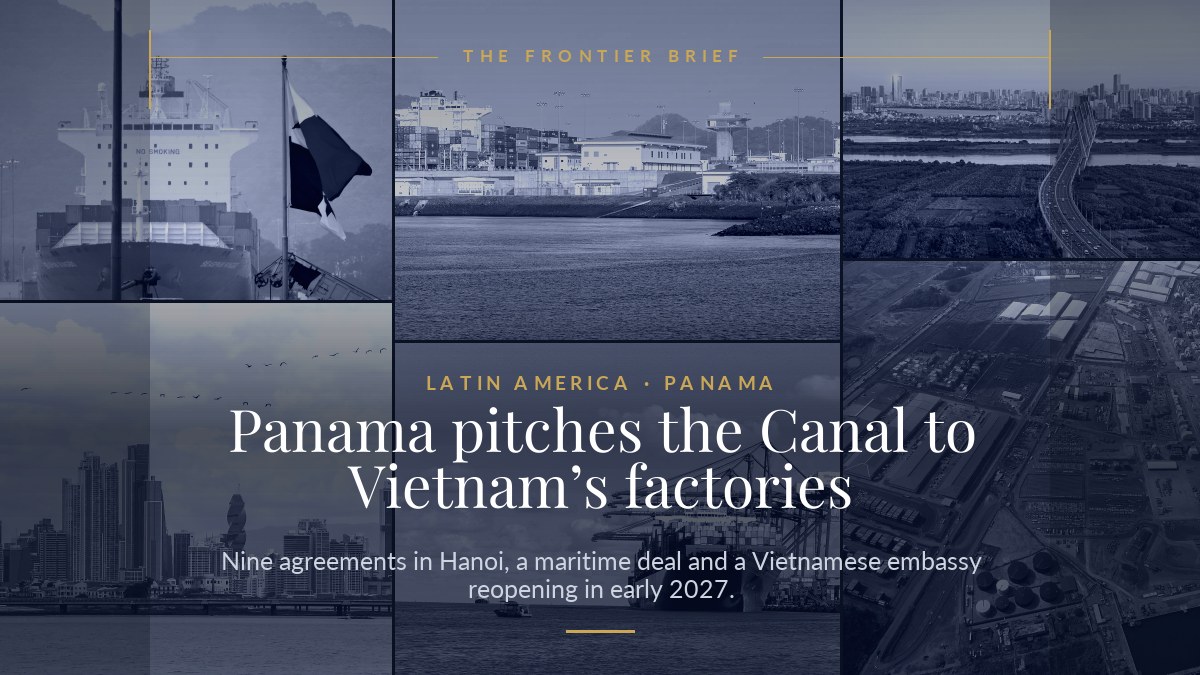
President José Raúl Mulino spent 5–8 October in Vietnam selling one idea — that Vietnam’s export industry should reach the Americas through Panama — and came away with nine agreements and a Vietnamese embassy on the way.
President José Raúl Mulino’s official visit to Vietnam ran from 5 to 8 October. On 6 October he and To Lam, Vietnam’s president and Communist Party general secretary, witnessed the signing of nine cooperation agreements, including on maritime transport, agriculture and security. Mulino travelled with the delegation of a logistics company rather than a foreign ministry: Foreign Minister Javier Martínez-Acha, Canal Affairs Minister José Ramón Icaza, Agriculture Minister Roberto Linares and the general manager of Tocumen International Airport.
The pitch was explicit. “Vietnam has built an impressive industrial and export capacity, and I have told President To Lam that Panama wants to become a gateway for that industry into Latin America and the Caribbean,” Mulino said, listing the Canal, the ports, air and sea connectivity, an international financial centre and the country’s logistics platform. To Lam answered in kind: Vietnam will reopen an embassy in Panama in early 2027 and wants to use the country’s free zones and the Canal as its bridge into the region. More than 47 Vietnamese shipping and maritime companies attended a meeting with the Panamanian delegation, and a business forum followed in Hanoi on 7 October, the day the two governments issued a joint statement committing to work together on port logistics, finance, banking, tourism and transport.
Why it matters
Both countries are selling the same asset: position. Vietnam sits at the manufacturing end of the Pacific, Panama at the point where Pacific cargo is redistributed across two oceans and a continent. A factory in Hai Phong does not need Panama to reach Los Angeles. It may well need it to reach Bogotá, Santo Domingo or São Paulo with regional inventory, financing and after-sales under one roof — which is what free zones, a financial centre and a hub airport are for. The visit turns that logic into paper: an embassy, a maritime agreement, and a room full of shipowners.
There is a second thread. The joint statement records Panama’s appreciation that Vietnam was the first country to sign the protocol to the treaty on the permanent neutrality and operation of the Canal, and Mulino had flown in from Singapore, which has expressed its intention to accede as well. Panama is collecting Asian signatures for the Canal’s neutrality at the same time as it collects Asian customers for its ports. The agreements still have to become projects — Mulino said as much in Hanoi — but the direction is clear: a small country is using the one thing nobody can relocate to make itself useful to Asia’s exporters.
Sources: Vietnam News Agency · Việt Nam News · EFE / Infobae · Prensa Latina · Newsroom Panama · Destino Panamá