Poland enters 2026 as one of the European Union’s most dynamic large economies. After more than three decades of structural transformation, it has combined macroeconomic stability with industrial depth. The International Monetary Fund projects GDP growth of around 3%–3.5% in the coming two years, supported by domestic demand, EU-backed investment and strengthening private consumption. Inflation has moderated from recent highs, reinforcing a stable operating environment for business.
Trade performance underscores the country’s strategic relevance. With goods exports exceeding $350 billion annually, Poland ranks among the world’s leading exporting nations. Germany remains its largest trading partner, but supply-chain integration stretches across the entire European Union and increasingly into global markets. For investors, this export intensity signals more than volume — it confirms Poland’s role as a core production and distribution platform within Europe.
Geography amplifies that advantage. Positioned at the intersection of North–South and East–West corridors, Poland connects the Baltic to the Adriatic and Western Europe to emerging eastern markets. In an era defined by nearshoring and supply-chain resilience, that connectivity is no longer incidental. It is strategic.
Building the Backbone of European Logistics
The evolution of Poland’s logistics infrastructure illustrates how the country has moved up the value chain. In Wielkopolska, CLIP Group has built an integrated logistics and industrial platform combining intermodal terminals, warehousing, automotive distribution and rail operations into a scalable ecosystem.
“We are the largest family-owned logistics group in Poland, focused on low-emission rail-based intermodal transportation,” said Agnieszka Hipś, President of the Management Board. That emphasis on rail aligns directly with Europe’s decarbonization agenda and the growing demand for measurable ESG performance across supply chains.
The group’s strength lies in long-term partnerships and operational reliability. “We were never left by any of our customers,” Hipś said — a statement that speaks to performance in sectors where multinational corporations regularly retender high-volume contracts. Retention in such an environment is a competitive marker.
Looking ahead, expansion remains central to the strategy. “Capacity, capacity, capacity,” Hipś insists, signaling a clear commitment to scaling terminals, rolling stock and industrial land to meet the demands of nearshoring and energy-intensive investment. The objective is not incremental growth, but transformation: evolving from a national logistics leader into a regional infrastructure partner for Europe.
Industrial Agility and Execution Under Pressure
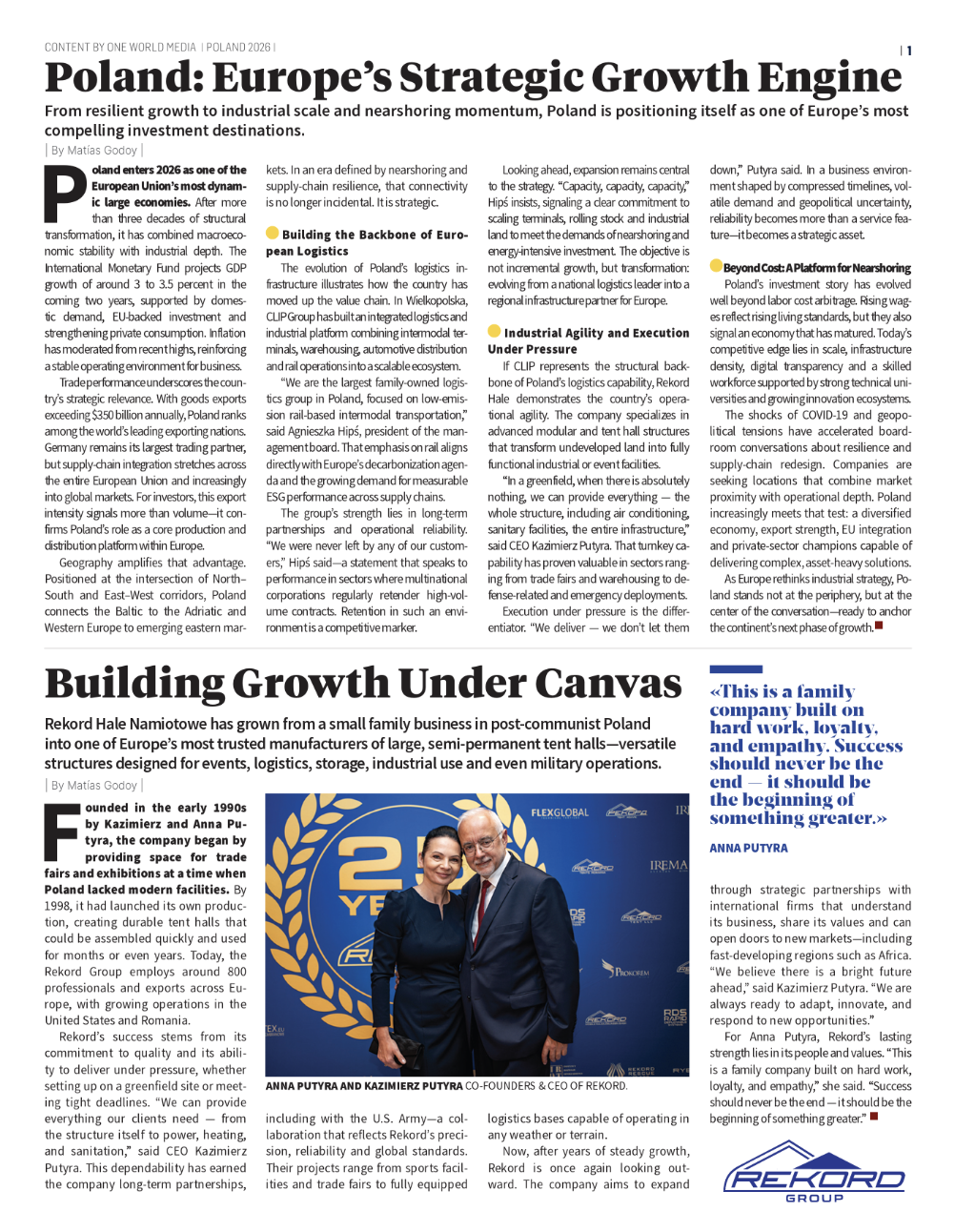
If CLIP represents the structural backbone of Poland’s logistics capability, Rekord Hale demonstrates the country’s operational agility. The company specializes in advanced modular and tent hall structures that transform undeveloped land into fully functional industrial or event facilities.
“In a greenfield, when there is absolutely nothing, we can provide everything — the whole structure, including air conditioning, sanitary facilities, the entire infrastructure,” said CEO Kazimierz Putyra. That turnkey capability has proven valuable in sectors ranging from trade fairs and warehousing to defense-related and emergency deployments.
Execution under pressure is the differentiator. “We deliver — we don’t let them down,” Putyra said. In a business environment shaped by compressed timelines, volatile demand and geopolitical uncertainty, reliability becomes more than a service feature — it becomes a strategic asset.
Beyond Cost: A Platform for Nearshoring
Poland’s investment story has evolved well beyond labor cost arbitrage. Rising wages reflect rising living standards, but they also signal an economy that has matured. Today’s competitive edge lies in scale, infrastructure density, digital transparency, and a skilled workforce supported by strong technical universities and growing innovation ecosystems.
The shocks of COVID-19 and geopolitical tensions have accelerated boardroom conversations about resilience and supply-chain redesign. Companies are seeking locations that combine market proximity with operational depth. Poland increasingly meets that test: a diversified economy, export strength, EU integration, and private-sector champions capable of delivering complex, asset-heavy solutions.
As Europe rethinks industrial strategy, Poland stands not at the periphery, but at the center of the conversation—ready to anchor the continent’s next phase of growth.