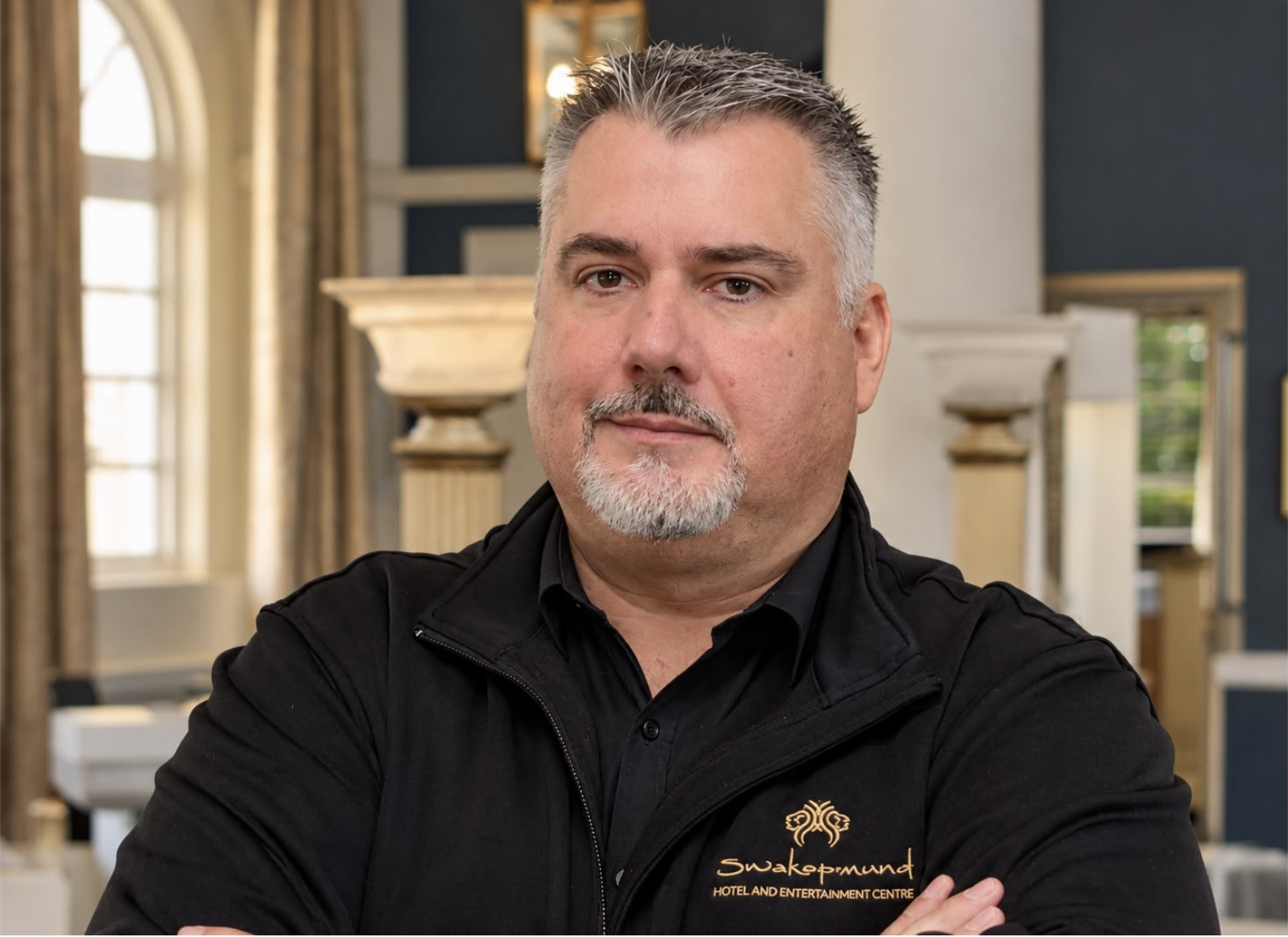
1. Swakopmund is one of Namibia’s most established tourism destinations, positioned between the Atlantic coast and the Namib Desert. From your perspective, what makes the town particularly attractive to international visitors, and how do you see its role evolving within Namibia’s tourism strategy?
I think it’s particularly attractive because it is a premier destination of Namibia. Now, why is it a premier destination? Well, it’s between the Atlantic and the desert. Its unique features, landscapes, diversity. We are considered an activity or adventure hub, which naturally attracts a lot of attention.
Besides all the activities and the adventure, the Swakopmund Hotel & Entertainment Centre has one of the oldest buildings in town, which used to be the railway station. It’s 125 years old, and a national heritage monument of the town. The fact that it has a history adds to the destination.
There are icons here in this town that people are attracted to and want to see. Balancing that history with the modern world is quite interesting, so from a strategic point, we’re sitting in a very good position. Everybody wants to see the southern part of Namibia and everyone wants to come to an adventure hub, as we like to call it.
The business opportunities which arise from the mining and lately oil and gas companies around Swakopmund. This also makes it an attractive destination for the business world.
We can’t leave out Namibia’s charm and hospitality. We’re sitting in a unique position that you just have to come and experience.
2. The hotel combines accommodation with substantial conference and event facilities. How much potential do you see for Swakopmund to become a stronger destination for international conferences, corporate events, investment delegations and business tourism?
It’s definitely a market we need to grow, because the potential is there, like I said, with oil and gas and international conferences that can be hosted here. We have the infrastructure to support these kinds of events and would like to ensure the international community is aware that we can host them.
We need to enhance our infrastructure by keeping our staff trained and skill sets enhanced to deliver the best service. I wouldn’t like to differentiate, but there is a certain difference between a leisure and a corporate client, and we need to be able to satisfy both in that aspect.
We don’t train our staff to attend to the different segments specifically, because every guest that walks through our doors should be treated the same, but flexibility comes in with their needs. A corporate client might not need a pool towel to lie at the pool, but would need good Internet access to do business. That’s what I’m referring to, having your infrastructure or facilities upgraded in such a way that can support their needs. But when it comes to service, there shouldn’t be any differentiation.
3. As Namibia seeks to diversify its tourism offering, what more can be done to encourage international visitors and business travellers to spend longer periods in destinations such as Swakopmund rather than concentrating their stays primarily in Windhoek?
The Hospitality Association of Namibia is putting a lot of effort towards that. The challenges we need to address are people waiting longer than expected in customs, even when they’re coming in with visas. It takes time to find proper solutions and to make it better and faster. The other big challenge is transport to get here, air flights, car hires, is not usually cheap. We’re constantly addressing challenges.
Collaboration between companies is the way forward to try and minimise costs to benefit the country as a whole.
There is also hard work around trying to get our airline back. That would be great, because it would be another airline bringing in business to the country. And then will come the need to upgrade the airports in such a way that this can be managed. There’s definitely some action there. It does look like we are moving in the right direction.
4. With accommodation, restaurants, conferencing, event spaces and the Mermaid Casino, the property offers considerably more than a traditional hotel. How important is this integrated approach to attracting different visitor segments and creating a more compelling destination experience?
I think it provides options for the clients. It’s not all based on accommodation. There’s entertainment, restaurants, gym facilities, the pool, and accommodation. There’s also Whistle Stop Lounge and of course, the conference facilities. Providing multiple facilities all under one roof which gives us a bit of an edge. We are building on that to make it as motivating and creative for the clients as possible. We have gotten a lot of business because clients walked in and said, “René, this is what we want”.
Everything is under one roof.
5. Are there any plans for expansion of the hotel in the future?
The owner from Legacy, who built this hotel around the station building, made provisions for expansion. With the current structure of the 90-room hotel we could add another 34 rooms. Structurally, it is built in such a way that we could add more rooms. It’s a cost factor. I would love it, as it would make the product bigger, different. Unfortunately, it’s not a cheap move. It also depends on the demand for accommodation, because competition is fierce. There’s a lot of accommodation establishments in Swakopmund. The town is getting bigger, which is great, but so is the competition. That means that there are investment opportunities in Swakopmund.
We are a state-owned entity, but I’m very sure that if investors are interested, they will be welcome. There is a possibility to sit around the table and discuss it. I’m sure that could be arranged.
6. Having combined international hospitality training with more than two decades of experience in Namibia, what changes are you seeing in international visitor expectations, and where does Namibia need to focus to remain competitive with other African and global tourism destinations?
I think we’re already competitive with our beautiful Namibia. We definitely need to be an example and supporter of our responsibilities and sustainability. How do we do it? Keeping the country clean, cost-effective, developing skill sets and creating jobs for our people is definitely a front-runner.
Tourism is a huge contributor to the economy. Not only because of the hotels, but also thanks to the tour operators, transport companies, restaurants, small retail businesses, small companies. Everybody gains, it’s a whole value chain that goes through. For example, the beds in our hotel are Namibian-made. For our fresh produce and meats, we also support local suppliers. If we can’t get it in Namibia, we also need to motivate it, so in the future we will. As a general manager, I like to support the locals first.
7. Looking ahead, what would you like Swakopmund Hotel to have achieved over the next five to ten years?
I would like people to know that if they hear Swakopmund or Namibia, and think about accommodation, they should think about Swakopmund Hotel. I guess every hotelier wants that in their life, but I also want the hotel to be distinguished for its service levels.
Obviously, maintaining our old station building, our monument, it’s a signature for us. So, we need to maintain it as good as possible, and then enhance our facilities in such a way that people want to come here. “Where are we going in Swakopmund? Go to the Swakopmund Hotel”, that’s what we’re aiming for.